My experience: Rome, Reunion and Redemption – a dream beyond arbitrary detention
Jorge L. Toledo was arbitrarily detained for 1,775 days as a political prisoner in Venezuela. He endured notorious prisons in which he survived brutal physical and psychological torture. He strongly believes that you can extract value out of adversity, obstacles and challenges, and hopes that his story will help others in any difficult life situation, but particularly those affected by hostage situations. Through his resilience, spiritual practices and mental strategies, Jorge found strength from the unwavering love of his wife and family. He has recently published a book, but his words here describe a dream that became reality beyond prison.
Captivity, by its very nature, compresses the human spirit. Dreams become currency. Hopes are traded quietly, almost furtively, in the shadows of what may never come. In El Helicoide, that sprawling, surreal prison in Caracas—a place shaped by paranoia and silence—every day felt like walking a tightrope between despair and a stubborn, defiant hope.
That is where I met Oreste: An Italian businessman, defiant in his own way, imprisoned not by circumstance, but by the politics that tore apart continents. Oreste was more than a cellmate to me – he became family, a confidant, and sometimes, in our muddled Spanish-English-Italian conversations, a gentle adversary. He was my student in music theory, listening as I plucked out diminished chords on a battered guitar, searching for harmony amid chaos.
Some days, we talked of geopolitics—heated words echoing off stone walls. Others, we simply let time unravel, dreaming aloud of freedom outside these concrete confines.
One night, while the air in our cell pressed down like a thick fog, Oreste leaned over and whispered, “If you ever come to Rome, after this madness, I’ll take you to the best pasta in the world—near the Foro Romano.”
His words conjured visions of sunlight, laughter, and ancient streets—so vivid that, for a moment, the crumbling paint and sour scents of El Helicoide disappeared. I rarely allowed myself to think so far ahead, but something about Oreste’s promise felt tangible. I replied, “If I do, I’ll pick the wine—the most expensive one they have.”
He grinned wide, thin lines etching around his eyes, and batted my shoulder. “Deal.”
I told him then about my wife Carmen, about Rome in 2016 after the New York Marathon—how she loved the city, its layers of old stones, the way it felt eternal. Oreste listened, a quiet wistfulness in his eyes. We fell into silence, letting hope fill the spaces where fear sometimes lived.
My release:
Years melt and harden inside a cell. Time means very little when every sunrise is measured by survival. My release came suddenly, through the machinery of international diplomacy—October 1, 2022, the day everything changed.
I stepped into the world, but my freedom was bittersweet. Oreste was left behind, his family desperate, waiting.
When Carmen died in March 2025, grief became my shadow. It followed me everywhere, even into joy. Loss sharpened everything; the memory of Rome with her became both a comfort and a wound.
In May, news arrived: Oreste was released, finally crossing the threshold into sunlight. I sat at my kitchen table, fingers trembling, reading that headline. Gratitude collided with grief. I wept for his freedom and for my own emptiness.
It took weeks to find his wife Katyana, and longer still to learn Oreste’s fate. “He’s in poor shape,” she said. “The hospital in Rome is trying, but the damage is deep.” Her words broke me open. The world outside prison does not heal you instantly.
Freedom can be heavy, a burden and a gift.
Months drifted by. One September day in 2025, my phone lit up—a video call. On the screen, Oreste appeared smaller, diminished, his oxygen tube stark against pale skin. His eyes, though, burned with the same stubborn light.
“Do you remember,” I asked, voice cracking, “that night in El Helicoide? The dream of pasta near the Foro Romano? I’m coming to Rome to see if you lied. And this time, I pick the wine.”
He pushed out a laugh, raspy but alive. “Come, my friend. Rome waits for you.”
Our reunion:
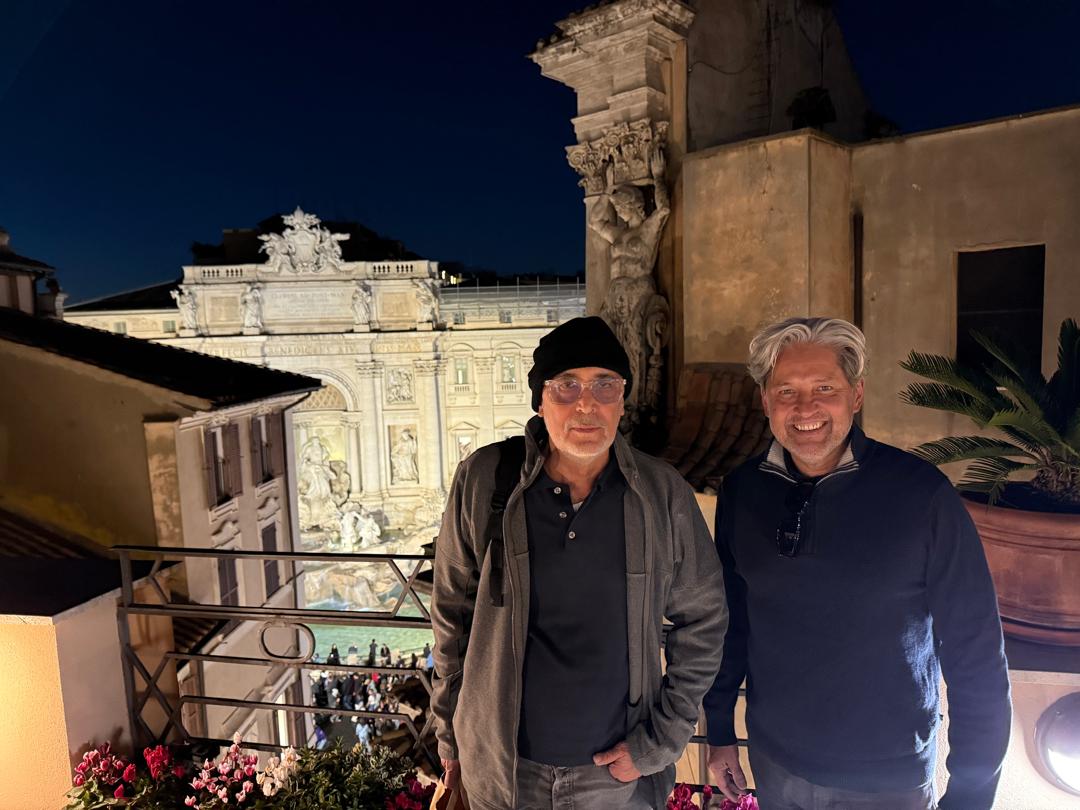
The flight was sleepless. Every memory—El Helicoide, Carmen, survival and loss—cycled through my mind. In Rome, I leased an apartment near Piazza Verbano. No sterile, anonymous hotel this time; I wanted roots, however temporary. The old neighborhood soothed me. There were grandmothers with grocery bags, children playing under the orange trees, and the gentle hum of life untouched by trauma.
Within an hour, Oreste called. “Come for lunch. I’ve sent a cab.” At his mother’s apartment, I saw him standing on the curb. He smiled through pain, waiting—waiting like we used to wait in prison, believing that some stranger would bring news of release.
We hugged in the street, awkward and fierce. “Ragazzo,” I whispered, “our prison dream is reality now.”
Inside, his family greeted me—his mother Gladis, sister Marinella, and Katyana. Each embrace was a new beginning. I handed Katyana my book, 1,775 Days of Captivity. She ran her fingers over the cover, eyes damp. For a moment, I wanted to laugh and sob and let gratitude pour out unfiltered.
“I want to laugh and cry at the same time,” I told Katyana. She smiled, understanding too well. The dining room filled with the scents of Rome; the table was a celebration of endurance.
Oreste wanted every detail of my release; his curiosity was raw. I shared what I could—the bewildering rush, the sense of unreality, the weight of American intervention. “Read the chapters,” I told him, gesturing to my book. “Some truths require more time than a meal gives us.”
That afternoon, after the hugs, food, and storytelling, I retreated to my rented apartment for a quiet moment. The city’s sounds drifted in from the window—life undiminished and ongoing. My thoughts wandered back to Carmen, to the thousand quiet sacrifices of families whose lives are bent by imprisonment and distance. It is not governments, but loved ones, that heal us. It is not officials, but faith and persistence, that break the chains.
I remembered running those Roman streets—2016, Carmen’s joy in the sun, Oreste’s promise echoing across years of separation. Freedom is never simple; it bruises and mends, it hurts and lifts. In its true form, it feels like forgiveness.
When evening came, Oreste was ready. We drove through the lamp-lit avenues, past the Foro Romano, until the city seemed to breathe with us—a rhythm forged by centuries, and now by survival.
The restaurant was tucked in a narrow corridor. No velvet tablecloths or gilded mirrors—just stone, flickering candles, and the gentle music of people living life. Oreste ordered the pasta, simple and perfect. The waiter uncorked a bottle of wine—Oreste’s choice this time, not mine. We ate in silence, laughter mingling with tears.
“So,” he said at last, “does it live up to the legend?”
I lifted my glass, looking him in the eyes. “You were right. This is the best pasta in the world—not for the flavour alone, but for the promise kept.”
Outside, the city whispered—ancient and eternal, holding the stories of two men, once prisoners, now free. That night, redemption tasted of sage, salt, and courage, and the wine of memory never ran dry.
In Rome, friendship became legacy. Every word shared in that old cell, every dream bounced off walls of concrete, every vow spoken in desperation found its answer in freedom. There are meals you remember all your life—not for taste, but for the miracle of the company.
And sometimes, if you’re lucky, a daydream in a dungeon becomes a feast in Rome, and the world opens itself again, as if to say: survive, love, remember, begin.
Read more of Jorge’s story:
1,775 Days of Captivity: Survival and Growth, a biography/memoir by Jorge L. Toledo is available online at:
www.amazon.com
www.barnesandnoble.com
www.archwaypublishing.com
November 2025